users online
 
Contact me

BRUCE SPRINGSTEEN CONCERT, OBAMA INAGURATION, WASHINGTON DC

In Obama Inaguration there were some artists who support to Obama that made a free concert in Licoln Memorial in Washington DC. One of the was Bruce Springsteen, who we had the opportunity to see him.


There you have a video of him singing:


MUSEUM OF AMERICA HISTORY, WASHINGTON DC

My YOUTUBE video of WASHINGTON


The National Museum of American History collects, preserves and displays American heritage in the areas of social, political, cultural, scientific and military history. The museum is administered by the Smithsonian Institution and located in Washington, D.C., on the National Mall.

The museum first opened in 1964 as the Museum of History and Technology. The building was one of the last structures designed by renowned architectural firm McKim Mead & White. In 1980 the museum was renamed The National Museum of American History to better represent its basic mission—the collection, care and study of objects that reflect the experience of the American people. It once had a large pendulum in the center of the building that has since been removed. The museum displays the original flag that inspired Francis Scott Key and Dorothy's ruby slippers from the film The Wizard of Oz.

The museum temporarily closed on September 5, 2006 for a two-year renovation. The architectural firm Skidmore, Owings and Merrill (SOM) of New York and Turner Construction are responsible for the overall design and construction. New York-based design firm Chermayeff & Geismar will work with SOM on the new permanent gallery for the Star-Spangled Banner A grand reopening festival was November 21, 2008.

After being closed for two years of renovations, the National Museum of American History reopened to shed new light on American history, literally and figuratively. The renovated museum includes a five-story sky-lit atrium, surrounded by artifact displays showcasing the breadth of the museum's three million objects from the cultural, social, technological and political history of the United States. A grand staircase now links the museum's first and second floors and six landmark objects located in the wings of each of the three exhibition floors help orient visitors. New galleries such as the Jerome and Dorothy Lemelson Hall of Invention join old ones like "The American Presidency: A Glorious Burden" and "America on the Move". The Star-Spangled Banner Flag has been given a new state of the art home at the heart of the museum. The grand reopening starts off a year of new exhibition openings culminating in summer 2009.

January 2009

BARACK OBAMA INAGURATION 2009, WASHINGTON DC

My YOUTUBE video of WASHINGTON


The inauguration of Barack Obama as the forty-fourth President of the United States took place on January 20, 2009. The inauguration, with a record attendance for any event held in Washington, D.C., marked the commencement of the four-year term of Barack Obama as President and Joseph Biden as Vice President. With his inauguration as President of the United States, Obama became the first African American to hold the office and the first President born in Hawaii. The theme of the 56th inauguration was "A New Birth of Freedom," commemorating the 200th anniversary of the birth of Abraham Lincoln.

The inauguration celebration commenced on January 17, 2009 with a train ride beginning in Philadelphia, Pennsylvania. Official events were held in Washington, D.C. from January 18 to 21, 2009, including the We Are One: The Obama Inaugural Celebration at the Lincoln Memorial, a day of service on the federal observance of the Martin Luther King, Jr. Day, a "Kids' Inaugural: We Are the Future" concert event at the Verizon Center, the inaugural ceremony at the U.S. Capitol, an inaugural luncheon at National Statuary Hall, a parade along Pennsylvania Avenue, a series of inaugural balls at the Washington Convention Center and other locations, a private White House gala and an inaugural prayer service at the Washington National Cathedral.

The commencement of the 2009 inauguration activities began with a train ride to commemorate Abraham Lincoln, the sixteenth President of the United States and a former Illinois politician, by partially re-enacting Lincoln's 1861 train ride to Washington, D.C. At 10:00 a.m. EST on January 17, 2009, Obama began the tribute by holding a town hall meeting at the 30th Street Station in Philadelphia before embarking on the train ride at 11:00 a.m. EST. By 11:30 a.m. EST, Obama reached Wilmington, Delaware to pick up Vice President-elect Biden in the Georgia 300, a railroad car used by past presidents. Obama and Biden then continued to Baltimore, Maryland where Obama spoke to a crowd of around 40,000 people. The Federal Aviation Administration (FAA) prevented private planes, news helicopters, balloonists and others from flying anywhere near the airspace above the train route. Obama and Biden arrived at Union Station in Washington, D.C. at 7:00 p.m. EST.

During his time, Lincoln began his tour in Springfield, Illinois on February 11, 1861 before arriving in Philadelphia, Pennsylvania on February 21, 1861 to complete the first phase of his train tour. In the second phase of the tour, Lincoln traveled to his 1861 inauguration in Washington, D.C. by chartered train from Philadelphia, stopping in 70 places along the way.

The eve of the inauguration day, January, 19, 2009, fell on Martin Luther King, Jr. Day, a federal holiday recognizing King's birthday. Obama called for a national day of service on this day. Both Obama and Biden participated in the activities, and the Presidential Inauguration Committee provided information through its website about how to host community service projects, along with information about a broad range of national service organizations, to motivate participation. Obama described the day of service on the holiday as a natural observance: "As we honor that legacy, it's not a day just to pause and reflect — it's a day to act."

On January 19, 2009, the presidential motorcade departed at 8:33 a.m. from Blair House enroute to Walter Reed Army Medical Center, where Obama spent a little more than an hour with wounded service members and their families. In a private setting, Obama met with 14 service members recovering from wounds sustained in the Iraq War and the War in Afghanistan. Obama and Martin Luther King, III then headed to the Sasha Bruce House homeless shelter for teens in Washington, D.C., while Jill and Ashley Biden, Michelle Obama, and Obama's daughters Malia and Sasha, along with hundreds of volunteers, spent the morning at Robert F. Kennedy Stadium where they helped fill 60,000–85,000 care packages destined for U.S. troops overseas. After a morning of service activities, the Obamas and Bidens met for lunch at Coolidge High School, a school located in N.W. Washington, D.C. Joe Biden spent part of his day hanging drywall at a Habitat for Humanity home in N.E. Washington, D.C., as others continued to perform numerous service activities throughout the city on that day. Nationwide over 11,000 service events occured. During the evening, Obama hosted three separate bipartisan dinners, honoring the service of John McCain, Colin Powell and Joe Biden.


January 2009

KOREAN WAR MEMORIAL, WASHINGTON DC

My YOUTUBE video of WASHINGTON

The Korean War Veterans Memorial is located in Washington, D.C.'s West Potomac Park, southeast of the Lincoln Memorial and just south of the Reflecting Pool on the National Mall.

The Korean War Veterans Memorial was authorized by the U.S. Congress (Public Law 99-572) on October 28, 1986, with design and construction managed by the Korean War Veterans Memorial Advisory Board and the American Battle Monuments Commission. President George H. W. Bush conducted the groundbreaking for the Memorial on June 14, 1992, Flag Day. It was dedicated on July 27, 1995, the 42nd anniversary of the armistice that ended the war, by President Bill Clinton and Kim Young Sam, President of the Republic of Korea, to the men and women who served during the conflict. Management of the memorial was turned over to the National Park Service, under its National Mall and Memorial Parks group. As with all National Park Service historic areas, the memorial was administratively listed on the National Register of Historic Places on the day of its dedication.

The memorial is in the form of a triangle intersecting a circle. Within the triangle are 19 stainless steel statues designed by Frank Gaylord, each larger than life-size, between 7 feet 3 inches and 7 feet 6 inches. The figures represent a squad on patrol, drawn from each branch of the armed forces; fifteen of the figures are from the U.S. Army, two are from the Marine Corps, one is a Navy Corpsman, and one is an Air Force Forward Air Observer. They are dressed in full combat gear, dispersed among strips of granite and juniper bushes which represent the rugged terrain of Korea. To the north of the statues is a path, forming one side of the triangle. Behind, to the south, is a 164 foot-long black granite wall, created by Louis Nelson, with photographic images sandblasted into it depicting soldiers, equipment and people involved in the war. This forms the second side of the triangle. The third side of the triangle, facing towards the Lincoln Memorial, is open.

To the north of the statues and path is the United Nations Wall, a low wall listing the 22 members of the United Nations that contributed troops or medical support to the Korean war effort.

The circle contains the Pool of Remembrance, a shallow 30-foot-diameter pool lined with black granite and surrounded by a grove of trees with benches. Inscriptions list the numbers killed, wounded, missing in action, and held as prisoners of war, and a nearby plaque in inscribed: "Our nation honors her sons and daughters who answered the call to defend a country they never knew and a people they never met." Additionally, right next to the numbers of American soldiers are those of the United Nations troops in the same categories. In the south side of the memorial, there are three bushes of the Rose of Sharon hibiscus plant, South Korea's national flower.

A further granite wall bears the simple message, inlaid in silver: "Freedom Is Not Free".


January 2009

ABRAHAM LICOLN MEMORIAL MONUMENT, WASHINGTON DC

My YOUTUBE video of WASHINGTON

The Lincoln Memorial is a United States Presidential memorial built to honor the 16th President of the United States, Abraham Lincoln. It is located on the National Mall in Washington, D.C. The architect was Henry Bacon, the sculptor was Daniel Chester French, and the painter of the interior murals was Jules Guerin.

The building is in the form of a Greek Doric temple and contains a large seated sculpture of Abraham Lincoln and inscriptions of two well-known speeches by Lincoln. The memorial has been the site of many famous speeches, including Martin Luther King's "I Have a Dream" speech, delivered on August 28, 1963 during the rally at the end of the March on Washington for Jobs and Freedom.

Like other monuments on the National Mall – including the nearby Vietnam Veterans Memorial, Korean War Veterans Memorial, and National World War II Memorial – the memorial is administered by the National Park Service under its National Mall and Memorial Parks group. It has been listed on the National Register of Historic Places since October 15, 1966. It is open to the public 24 hours a day. In 2007, it was ranked seventh on the List of America's Favorite Architecture by the American Institute of Architects.

The Lincoln Monument Association was incorporated by the United States Congress in March 1867 to build a memorial to Lincoln. A site was not chosen until 1901, in an area that was then swampland. Congress formally authorized the memorial on February 9, 1911, and the first stone was put into place on Lincoln's birthday, February 12, 1914. The monument was dedicated by Former President and Chief Justice William Howard Taft on May 30, 1922, a ceremony attended by Lincoln's only surviving child, Robert Todd Lincoln. The stone for the building is Indiana limestone and Yule marble, quarried at the town of Marble, Colorado. The Lincoln sculpture within is made of Georgian marble, quarried at the town of Tate, Georgia. In 1923, designer Henry Bacon received the Gold Medal of the American Institute of Architects, his profession's highest honor, for the design of the memorial. Originally under the care of the Office of Public Buildings and Public Parks, it was transferred to the National Park Service on August 10, 1933

Standing apart from the somewhat triumphal and Roman manner of most of Washington, the memorial takes the severe form of a Greek Doric temple. It is "peripteral", with 36 massive columns, each 37 feet (10 m) high, surrounding the cella of the building itself, which rises above the porticos. As an afterthought, the 36 columns required for the design were seen to represent the 25 U.S. states at the time of Lincoln's death, as well as the 11 seceded States, and their names were inscribed in the entablature above each column. The names of the 48 states of the Union when the memorial was completed are carved on the exterior attic walls, and a later plaque commemorates the admission of Alaska and Hawaii in 1959.

The main influence on the style of the Lincoln Memorial was the Temple of Zeus in Olympia, Greece. The focus of the memorial is Daniel Chester French's sculpture of Lincoln, seated on a throne. French studied many of Mathew Brady's photographs of Lincoln and depicted the president as worn and pensive, gazing eastwards down the Reflecting Pool toward the capital's starkest emblem of the Union, the Washington Monument. Beneath his hands, the Roman fasces, symbols of the authority of the Republic, are sculpted in relief on the seat. The statue stands 19 feet 9 inches (6 m) tall and 19 feet (6 m) wide, and was carved from 28 blocks of white Georgia marble by the Piccirilli Brothers studio of Brooklyn, New York.

January2009

THOMAS JEFFERSON MEMORIAL MONUMENT, WASHINGTON DC

My YOUTUBE video of WASHINGTON

The Thomas Jefferson Memorial is a presidential memorial in Washington, D.C. that is dedicated to Thomas Jefferson, an American Founding Father and the third president of the United States. The neoclassical building was designed by John Russell Pope. It was built by Philadelphia contractor John McShain. Construction began in 1939, the building was completed in 1942, and the bronze statue of Jefferson was added in 1947. When completed, the memorial occupied one of the last significant sites left in the city.

Composed of circular marble steps, a portico, a circular colonnade of Ionic order columns, and a shallow dome, the building is open to the elements. Pope made references to the Roman Pantheon and Jefferson's own design for the Rotunda at the University of Virginia. It is situated in West Potomac Park, on the shore of the Tidal Basin of the Potomac River. The Jefferson Memorial, and the White House located directly north, form one of the main anchor points in the area of the National Mall in D.C. The Washington Monument, just east of the axis on the national Mall, was intended to be located at the intersection of the White House and the site for the Jefferson Memorial to the south, but soft swampy ground which defied nineteenth century engineering required it be sited to the east.The Jefferson Memorial is managed by the National Park Service under its National Mall and Memorial Parks division. In 2007, it was ranked fourth on the List of America's Favorite Architecture by the American Institute of Architects.


January 2009

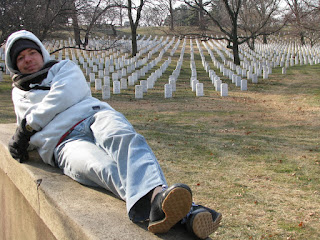
ARLINGTON NATIONAL CEMENTERY, WASHINGTON DC

My YOUTUBE video of WASHINGTON


Arlington National Cemetery, in Arlington, Virginia, is a military cemetery in the United States, established during the American Civil War on the grounds of Arlington House, formerly the estate of the family of Robert E. Lee's wife Mary Anna (Custis) Lee, a descendant of Martha Washington. The cemetery is situated directly across the Potomac River from Washington, D.C. and near The Pentagon. It is served by the Arlington Cemetery station on the Blue Line of the Washington Metro system.

More than 290,000 people are buried in an area of 624 acres (2.53 km2). Veterans and military casualties from every one of the nation's wars are interred in the cemetery, from the American Revolution through the military actions in Afghanistan and Iraq. Pre-Civil War dead were reinterred after 1900.

Arlington shares with Mill Springs National Cemetery, the only other open cemetery in the system, the distinction of being the oldest military burial ground in the United States.

The first soldier to be buried in Arlington was Private William Henry Christman on May 13, 1864.

Arlington National Cemetery and United States Soldiers' and Airmen's Home National Cemetery are administered by the Department of the Army. The other National Cemeteries are administered by the Department of Veterans Affairs or by the National Park Service.

Arlington House (Custis-Lee Mansion) and its grounds are administered by the National Park Service as a memorial to Lee.

American military cemeteries developed from the duty of commanders on the frontier and in battle to care for their casualties. When Civil War casualties overflowed hospitals and burial grounds near Washington, D.C., Quartermaster General Montgomery C. Meigs proposed in 1864 that 200 acres (0.81 km2) of the Robert E. Lee family property at Arlington be taken for a cemetery.

"The grounds about the mansion", Meigs wrote, "are admirably adapted to such a use." Burials had in fact begun at Arlington before the ink was even blotted on Meigs's proposal. By war's end, 16,000 graves filled the spaces close to the house.

Custis Lee, heir to the property, sued the government claiming ownership of the land. After the Supreme Court ruled in Lee's favor, Congress paid him $150,000 for title to the land.

Before the Civil War, Robert E. Lee had been a West Point graduate and a United States Army officer. When Fort Sumter was forced to surrender, President Abraham Lincoln offered Lee the command of the Federal army. Lee demurred, because he wanted to see how Virginia would decide.

When Virginia announced its secession, Lee resigned his commission and took command of the armed forces of the state of Virginia, and later became commander of the Army of Northern Virginia. He quickly established himself as an able commander, defeating a series of Union generals, until his final defeat and surrender at Appomattox Court House.

Because of this decision and subsequent performance, Lee was regarded as disloyal by most Union officers. The decision was made to appropriate his farm as a graveyard for mostly Union dead.

In Arlington National Cemetery, Memorial Day has been celebrated. On May 30, 1968, the first national ceremony for Memorial Day took place in Arlington Nation Cemetery by the President Lyndon B. Johnson.

The Tomb of the Unknowns is part of the Arlington Memorial Amphitheater. The Memorial Amphitheater has hosted state funerals and Memorial Day and Veterans Day ceremonies. Ceremonies are also held for Easter. About 5,000 people attend these holiday ceremonies each year. The structure is mostly built of Imperial Danby marble from Vermont. The Memorial Display room, between the amphitheater and the Tomb of the Unknowns, uses Botticino stone, imported from Italy. The amphitheater was the result of a campaign by Ivory Kimball to construct a place to honor America's soldiers. Congress authorized the structure March 4, 1913. Woodrow Wilson laid the cornerstone for the building on October 15, 1915. The cornerstone contained 15 items including a Bible and a copy of the Constitution.

Before the Arlington Memorial Amphitheater was completed in 1921, important ceremonies were held at what is now known as the "Old Amphitheater." This structure sits where Robert E. Lee once had his gardens. The amphitheater was built in 1868 under the direction of General John A. Logan. Gen. James Garfield was the featured speaker at the Decoration Day dedication ceremony, May 30, 1868. The amphitheater has an encircling colonnade with a latticed roof that once supported a web of vines. The amphitheater has a marble dais, known as "the rostrum", which is inscribed with the U.S. national motto found on the Great Seal of the United States, E pluribus unum ("Out of many, one"). The amphitheater seats 1,500 people and has hosted speakers such as William Jennings Bryan.

Other frequently visited sites in the cemetery are the USMC War Memorial (commonly known as the "Iwo Jima Memorial") and the Netherlands Carillon (these sites are actually located adjacent to the cemetery), and the grave of President John F. Kennedy. Kennedy is buried with his wife and two of their children. He was placed here March 14, 1967. His grave is marked with an eternal flame. His brother, Senator Robert F. Kennedy, is also buried nearby. The latter's grave is marked by a simple cross.

The federal government dedicated a model community for freed slaves, Freedman's Village, near the current Memorial Amphitheater, December 4, 1863. More than 1,100 freed slaves were given land by the government, where they farmed and lived during and after the Civil War. They were turned out in 1890 when the estate was repurchased by the government and dedicated as a military installation.

Also, in the cemetery, there is a Confederate section with graves of soldiers of the Confederate States of America and a Confederate Memorial.

Near the Tomb of the Unknowns stands a memorial to the 266 men who lost their lives aboard the USS Maine. The memorial is built around a mast salvaged from the Maine's wreckage. (The Maine's other mast is erected at the United States Naval Academy, making the Maine the "longest ship in the Navy" in Naval Academy tradition.) The Maine Memorial has served as the temporary resting place for foreign heads of state allied with the United States who died in exile in the United States during the Second World War, pending the return of their remains to their homeland. These were Manuel L. Quezon of the Philippines and Ignacy Jan Paderewski of Poland.
The Tomb of the Unknowns at Arlington National Cemetery is also known as the Tomb of the Unknown Soldier. It stands on top of a hill overlooking Washington, D.C.

One of the more popular sites at the Cemetery, the tomb is made from Yule marble quarried in Colorado. It consists of seven pieces, with a total weight of 79 short tons (72 metric tons). The tomb was completed and opened to the public April 9, 1932, at a cost of $48,000.

It was initially named the "Tomb of the Unknown Soldier." Other unknown servicemen were later entombed there, and it became known as the "Tomb of the Unknowns", though it has never been officially named. The soldiers entombed there are:

Unknown Soldier of World War I, interred November 11, 1921. President Warren G. Harding presided.
Unknown Soldier of World War II, interred May 30, 1958. President Dwight D. Eisenhower presided.
Unknown Soldier of the Korean War, also interred May 30, 1958. President Dwight Eisenhower presided again, Vice President Richard Nixon acted as next of kin.
Unknown Soldier of the Vietnam War, interred May 28, 1984. President Ronald Reagan presided. The remains of the Vietnam Unknown were disinterred, under the authority of President Bill Clinton, on May 14, 1998, and were identified as those of Air Force 1st Lt. Michael J. Blassie, whose family had him reinterred near their home in St. Louis, Missouri. It has been determined that the crypt at the Tomb of the Unknowns that contained the remains of the Vietnam Unknown will remain empty.
The Tomb of the Unknowns is perpetually guarded by the U.S. Army. The 3rd U.S. Infantry Regiment ("The Old Guard") began guarding the Tomb April 6, 1948.


January 2009

WASHINGTON MEMORIAL MONUMENT, WASHINGTON DC

My YOUTUBE video of WASHINGTON

The Washington Monument is a large, tall, sand-colored obelisk near the west end of the National Mall in Washington, D.C. It is a United States Presidential Memorial constructed to commemorate the first U.S. president, George Washington. The monument, made of marble, granite, and sandstone, is both the world's tallest stone structure and the world's tallest obelisk, standing 555 feet 5⅛ inches (169.294 m) in height. It is also the tallest structure in Washington D.C. It was designed by Robert Mills, an architect of the 1840s. The actual construction of the monument began in 1848 but was not completed until 1884, almost 30 years after the architect's death. This hiatus in construction happened because of co-option by the Know-Nothing party, a lack of funds, and the intervention of the American Civil War. A difference in shading of the marble, visible approximately 150 feet (46 m) up, shows where construction was halted for a number of years. Its cornerstone was laid on July 4, 1848; the capstone was set on December 6, 1884, and the completed monument was dedicated on February 21, 1885. It officially opened October 9, 1888. Upon completion, it became the world's tallest structure, a title it inherited from the Cologne Cathedral and held until 1889, when the Eiffel Tower was finished in Paris, France.

The Washington Monument reflection can be seen in the aptly named Reflecting Pool, a rectangular pool extending to the west toward the Lincoln Memorial.

Above the Founding Fathers of the United States, George Washington earned the title "Father of the Country" in recognition of his leadership in the cause of American independence. Appointed as commander of the Continental Army in 1775, he molded a fighting force that won independence from the Kingdom of Great Britain. In 1787, as president of the Constitutional Convention, he helped guide the deliberations to form a government that has lasted for more than 200 years. Two years later he was unanimously elected the President of the United States. Washington defined the Presidency and helped develop the relationships among the three branches of government. He established precedents which successfully launched the new government on its course. He refused the trappings of power and veered from monarchical government and traditions and twice—despite considerable pressure to do otherwise—gave up the most powerful position in the Americas. Washington remained ever mindful of the ramifications of his decisions and actions. With this monument the citizens of the United States show their enduring gratitude and respect.

When the Revolutionary War ended, no man in the United States commanded more respect than George Washington. Americans celebrated his ability to win the war despite limited supplies and inexperienced men, and they admired his decision to refuse a salary and accept only reimbursements for his expenses. Their regard increased further when it became known that he had rejected a proposal by some of his officers to make him king of the new country. It was not only what Washington did but the way he did it: Abigail Adams, wife of John Adams, described him as "polite with dignity, affable without familiarity, distant without haughtiness, grave without austerity, modest, wise, and good."

Washington retired to his plantation at Mount Vernon after the war, but he soon had to decide whether to return to public life. As it became clear the Articles of Confederation had left the federal government too weak to levy taxes, regulate trade, or control its borders, men such as James Madison began calling for a convention that would strengthen its authority. Washington was reluctant to attend because he had business affairs to manage at Mount Vernon. If he did not go to Philadelphia, however, he worried about his reputation and about the future of the country. He finally decided that, since "to see this nation happy… is so much the wish of my soul," he would serve as one of Virginia's representatives. The other delegates during the summer of 1787 chose him to preside over their deliberations, which ultimately produced the U.S. Constitution.

A key part of the Constitution was the development of the office of president of the United States. No one seemed more qualified to fill that position than Washington, and in 1789 he began the first of his two terms. He used the nation's respect for him to develop respect for this new office, but he simultaneously tried to quiet fears that the president would become as powerful as the king the new country had fought against. He tried to create the kind of solid government he thought the nation needed, supporting a national bank, collecting taxes to pay for expenses, and strengthening the Army and Navy. Though many people wanted him to stay for a third term, in 1797 he again retired to Mount Vernon. Washington died suddenly two years later. His death restarted attempts to honor him. As early as 1783, the Continental Congress had resolved "That an equestrian statue of George Washington be erected at the place where the residence of Congress shall be established." The proposal called for engraving on the statue which explained it had been erected "in honor of George Washington, the illustrious Commander-in-Chief of the Armies of the United States of America during the war which vindicated and secured their liberty, sovereignty, and independence."

Ten days after Washington's death, a Congressional committee recommended a different type of monument. John Marshall, a Representative from Virginia (who later became Chief Justice of the Supreme Court) proposed that a tomb be erected within the Capitol. But a lack of funds, disagreement over what type of memorial would best honor the country's first president, and the Washington family's reluctance to move his body prevented progress on any project.


January 2009

WHITE HOUSE, WASHINGTON DC

My YOUTUBE video of WASHINGTON

The White House is the official residence and principal workplace of the President of the United States. Located at 1600 Pennsylvania Avenue NW in Washington, D.C., it was built between 1792 and 1800 of white-painted Aquia sandstone in the late Georgian style and has been the executive residence of every U.S. President since John Adams. When Thomas Jefferson moved into the home in 1801, he (with architect Benjamin Henry Latrobe) expanded the building outward, creating two colonnades which were meant to conceal stables and storage.

In 1814, during the War of 1812, the mansion was set ablaze by the British Army in the Burning of Washington, destroying the interior and charring much of the exterior walls. Reconstruction began almost immediately, and President James Monroe moved into the partially reconstructed house in October 1817. Construction continued with the addition of the South Portico in 1824 and the North in 1829. Due to crowding within the executive mansion itself, President Theodore Roosevelt had nearly all work offices relocated to the newly-constructed West Wing in 1901. Eight years later, President William Howard Taft expanded the West Wing and created the first Oval Office which was eventually moved as the section was expanded. The third-floor attic was converted to living quarters in 1927 by augmenting the existing hip roof with long shed dormers. A newly constructed East Wing was used as a reception area for social events; both new wings were connected by Jefferson's colonnades. East Wing alterations were completed in 1946 creating additional office space. By 1948, the house's load-bearing exterior walls and internal wood beams were found to be close to failure. Under Harry S. Truman, the interior rooms were completely dismantled, resulting in the construction of a new internal load-bearing steel framework and the reassembly of the interior rooms.

Today, the White House Complex includes the Executive Residence (in which the First Family resides), the West Wing (the location of the Oval Office, Cabinet Room, and Roosevelt Room), and the East Wing (the location of the office of the First Lady and White House Social Secretary), as well as the Old Executive Office Building, which houses the executive offices of the President and Vice President.

The White House is made up of six stories—the Ground Floor, State Floor, Second Floor, and Third Floor, as well as a two-story basement. The term White House is regularly used as a metonym for the Executive Office of the President of the United States and for the president's administration and advisors in general. The property is owned by the National Park Service and is part of the President's Park. In 2007, it was ranked second on the American Institute of Architects's List of America's Favorite Architecture.

The President's house was a major feature of Pierre Charles L'Enfant's plan for the newly established federal city, Washington, D.C. The architect of the White House was chosen in a competition, which received nine proposals, including one submitted anonymously by Thomas Jefferson. The nation's first president, George Washington, traveled to the site of the federal city on July 16, 1792, to make his judgment. His review is recorded as being brief and he quickly selected the submission of James Hoban, an Irishman living in Charleston, South Carolina. Washington was not entirely pleased with the original Hoban submission, however; he found it too small, lacking ornament, and not fitting the nation's president. On Washington's recommendation the house was enlarged by thirty percent; a large reception hall, the present East Room, was added. This was likely inspired by the large reception room at Mount Vernon.

The building Hoban designed is verifiably influenced by the first and second floors of Leinster House, in Dublin, Ireland, which later became the seat of the Oireachtas (the Irish parliament). Several other Georgian era Irish country houses have been suggested as sources of inspiration for the overall floor plan, details like the bow-fronted south front, and interior details like the former niches in the present Blue Room. These influences, though undocumented, are cited in the official White House guide, and in White House Historical Association publications. The first official White House guide, published in 1962, suggested a link between Hoban's design for the South Portico, and ChĆ¢teau de Rastignac, a neoclassical country house located in La Bachellerie in the Dordogne region of France and designed by Mathurin Salat. The French house was built 1812–1817, based on an earlier design. The link has been criticized because Hoban did not visit France. Supporters of a connection posit that Thomas Jefferson while visiting the Ɖcole SpĆ©ciale d'Architecture (Bordeaux Architectural College) in 1789 viewed Salat's drawings, and on his return to the U.S. shared the influence with Washington, Hoban, Monroe, and Benjamin Henry Latrobe.

Construction of the White House began with the laying of the cornerstone on October 13, 1792, with no formal ceremony. The main residence, as well as foundations of the house, were built largely by enslaved and free African-American laborers, as well as employed Europeans. Much of the other work on the house was performed by immigrants, many not yet with citizenship. The sandstone walls were erected by Scottish immigrants, employed by Hoban, as were the high relief rose and garland decorations above the north entrance and the "fish scale" pattern beneath the pediments of the window hoods. Much of the brick and plaster work was produced by Irish and Italian immigrants. The initial construction took place over a period of eight years, at a reported cost of $232,371.83 ($2.8 million in 2007 dollars). Although not yet completed, the White House was ready for occupancy on or circa November 1, 1800.

Shortages, including material and labor, forced alterations to the earlier plan developed by French engineer Pierre Charles L'Enfant for a "palace" that was five times larger than the house that was eventually built. The finished home would contain only two main floors instead of the planned three, and a less costly brick served as a lining for the stone faƧades. When construction was finished the porous sandstone walls were coated with a mixture of lime, rice glue, casein, and lead, giving the house its familiar color and name.

January 2009


------------------------------------------------------------------------------------------------------ MUCH MORE ------------------------------------------------------------------------------------------------------
Packing List

Subway Maps

Currency Exchange

View Guestbook Sign Guestbook Weather Transportation Accomodation Maps